
PageSpeed Benchmarks 2026 by Industry
By Rome Thorndike
What We Measured
We ran mobile PageSpeed Insights against the top 50 organic results for representative queries in each industry: "personal injury lawyer [city]", "primary care doctor near me", "homes for sale [city]", "[product category] buy online", and "B2B [tool category] software". For each industry, we recorded the median, the 25th percentile (sluggish floor), and the 90th percentile (industry leaders). All scores are mobile field data via CrUX, not lab data, and all scores were captured in April 2026.
One note before the numbers: mobile PageSpeed scores are systematically lower than desktop, and they drop further on competitive commercial queries because those pages tend to be heaviest. The numbers below are what your competitors look like on a mid-tier Android device on 4G. That is what Google uses for rankings.
Law Firms
The legal industry is uniformly slow. Median mobile PageSpeed across the top 50 personal injury results: 52. Sluggish floor (25th percentile): 38. Leaders (90th percentile): 74.
Why so slow: chat widgets (Ngage, Smith.ai, custom live chat) shipping 100 to 250KB of blocking JavaScript, video backgrounds in hero sections, image sliders that no one scrolls through, and WordPress themes built around heavy frameworks like Bridge, Avada, and Divi.
What the leaders do differently: clean WordPress installs with cached CDN delivery, lazy-loaded images, deferred chat widgets, and aggressive image compression. None of the top 10 law firm sites we audited hit 90+. The opportunity is wide open. A law firm site at 90+ mobile would outperform 95% of competitors on speed alone, before any other SEO work. Our take on this is in our law firm website design article and the dedicated law firm service page.
Medical Practices
Healthcare runs slightly faster than legal but still well below where it should be. Median: 58. Sluggish floor: 41. Leaders: 78.
The drag here is appointment booking widgets (Zocdoc embeds, NextHealth, custom portal iframes), insurance lookup tools, and patient-portal entry buttons that load early but render late. EHR vendors push patient-facing widgets that are not built for performance, and most practices accept the speed cost as a tradeoff for the booking integration.
The fix is decoupling: deliver static informational pages off the CDN, link out to the EHR portal for actual booking. The informational pages should hit 95+. The portal page can be slower because intent is high by the time the visitor clicks through. Our SEO for healthcare practices guide walks through the structure, and SharpPages for healthcare has the service angle.
Real Estate
Real estate is the worst performer in our dataset, hands down. Median: 34. Sluggish floor: 22. Leaders: 68.
The reason is structural: IDX feeds. Real estate sites pull live MLS data through embedded iframes or third-party IDX widgets (iHomeFinder, IDX Broker, Showcase IDX). These embeds load 500KB to 2MB of JavaScript per page, run their own database queries, and render client-side. PageSpeed never recovers.
The path forward: separate informational pages (about, neighborhood guides, agent bios, blog) from search pages. Build the informational pages as static HTML at 95+ scores. Keep IDX on dedicated search pages where slow speed is acceptable because the searcher knows they are using a tool. We cover this approach in real estate IDX alternatives.
E-commerce
E-commerce varies wildly by platform. Shopify median: 61. WooCommerce median: 44. BigCommerce median: 58. Custom-built leaders run 75 to 92 mobile.
Shopify carries a baseline overhead from its theme system and app ecosystem that caps most stores in the 60-75 range. Stores that hit 85+ have aggressively pruned apps, switched to a performance-tuned theme (Dawn or a custom build), and use only critical third-party scripts. WooCommerce stores struggle harder because they inherit WordPress overhead plus commerce-specific plugin bloat.
The 90+ ceiling for ecommerce typically requires a headless setup (static front-end pulling product data from Shopify or BigCommerce APIs) or a fully custom build. The investment is justified at scale; below $500K/year in revenue, the platform default is usually the right tradeoff.
B2B SaaS
B2B SaaS is the most polarized category. Median: 67. Sluggish floor: 41. Leaders: 94.
The split is platform: Webflow sites cluster in the 60-80 range. WordPress sites in the 40-65 range. Static or Next.js sites with proper SSG cluster at 88-99. The top SaaS sites in our data (Linear, Vercel, Stripe-adjacent, Plain) are all built statically and hit consistent 95+ scores.
What separates the leaders: zero third-party tracking scripts on landing pages (events fire from a single tag manager), self-hosted fonts, no chat widgets above the fold, and disciplined image sizing. The marketing site is treated as a performance product, not a content product. Our B2B SaaS website best practices article goes deeper, and SharpPages for B2B SaaS covers the service offer.
Conference Organizers and Events
Conference sites are bimodal. Pages built on Eventbrite or Bizzabo: median 39. Custom-built event sites: median 82. The platform overhead on registration platforms is structural and cannot be fixed by the organizer.
For a one-off event with low expected traffic, the platform overhead does not matter. For a recurring conference or a high-traffic launch, a custom static page is the right call. Our conference organizers page has the playbook.
Home Services and Med Spas
Both run in the 50-75 mobile range. The pattern is similar: WordPress with too many plugins, Wix or Squarespace defaults, and Calendly/Acuity booking embeds adding 100-200KB of late-loading JavaScript. Top performers in home services hit 85+; top med spas hit 80+. The leaders are usually agencies that committed to a single high-quality theme and refused to add plugins. See our notes on home services and med spas.
What Score Should You Target?
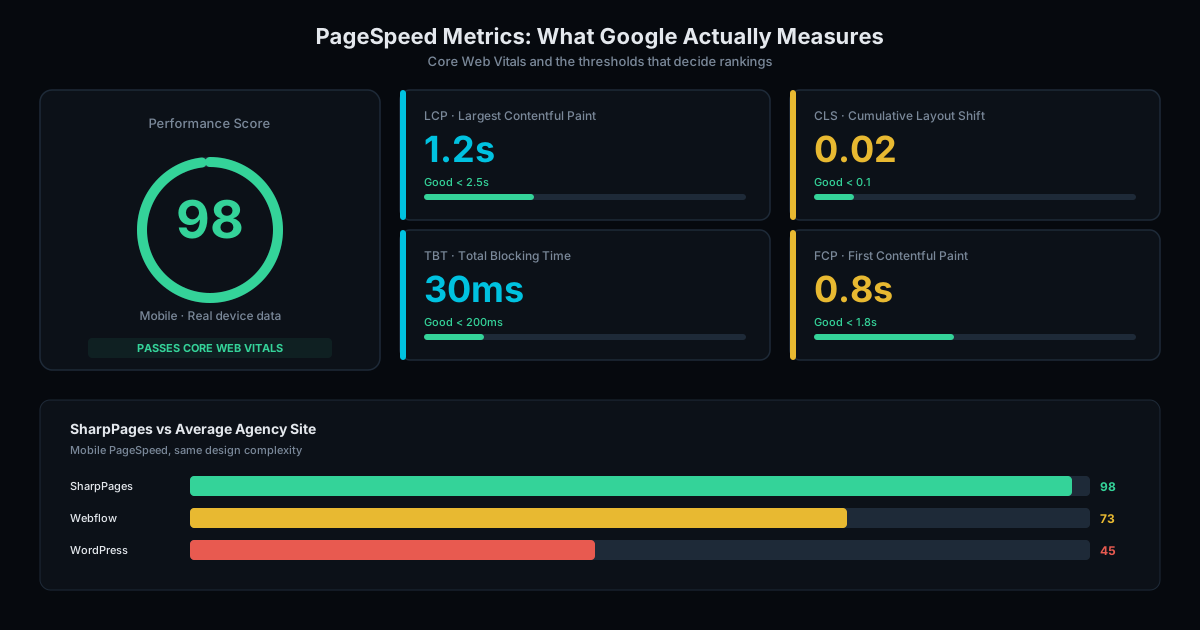
The honest answer: 90+ mobile is the right target if you can hit it within budget, 80+ is acceptable, anything below 70 should be the rebuild trigger. For a site at 50, optimization can usually get you to 70 but rarely higher. Above 80, the platform architecture becomes the ceiling. Our guide to scoring 90+ walks through the optimization order.
Run your own site through PageSpeed Insights or our free site audit first. If your score is well below the industry median for your category, you have a fixable problem. If you are above the median but below the leaders, the ceiling is your platform.
Frequently Asked Questions
What is a good PageSpeed score for my industry?
90+ mobile is the right target across all industries. Industry medians range from 34 (real estate) to 67 (B2B SaaS), but the median is not the goal. Leaders in every category hit 80+ and most can be reverse-engineered with focused optimization.
Why is real estate so slow?
IDX feeds. Live MLS data pulled through embedded widgets adds 500KB to 2MB of JavaScript per page. The fix is splitting informational pages (static HTML, 95+) from search pages (IDX, slower but acceptable in context).
Can WordPress hit 90+ mobile?
Rarely. With aggressive plugin pruning, a performance-tuned theme, edge caching, and image optimization, well-maintained WordPress sites can hit 80-85. Breaking through 90 consistently usually requires a static rebuild or a headless WordPress setup.
Does Shopify performance affect ecommerce conversion?
Yes. Below 60 mobile PageSpeed, every 100ms of additional load time costs 1-3% in mobile conversion. The Shopify baseline of 60-75 leaves money on the table for stores doing significant volume. Headless setups recover that gap.
Should I rebuild my site if PageSpeed is in the 60s?
Optimize first. Most sites in the 60s can reach 75-80 through image compression, script deferral, and plugin pruning at much lower cost than a rebuild. If optimization caps out below 80 and the site is on a platform with structural overhead, a rebuild becomes the right call.
Ready to Fill Your Next Event?
We build the page, set up the pixels, and run the ads. You run the event.

Rome Thorndike
Rome Thorndike is the Founder & CEO of SharpPages, which builds event websites around a clear commercial goal: turning audience interest into registrations. He previously led marketing and revenue at Firmograph and held enterprise sales roles at Microsoft and Salesforce.
Connect on LinkedIn