
Real Estate Website Design: IDX Alternatives That Load Fast
By Rome Thorndike
The IDX Problem
IDX (Internet Data Exchange) plugins pull MLS listing data into your website. The idea is good: visitors search listings on your site instead of Zillow. The execution is slow: IDX plugins load external JavaScript, query third-party databases in real-time, and render listing cards with heavy iframes.
A WordPress site with an IDX plugin (IDX Broker, Showcase IDX, iHomeFinder) typically scores 30-50 on mobile PageSpeed. The IDX widget alone can add 2-4 seconds to page load time. Google penalizes this with lower rankings: the opposite of what you want from a tool meant to attract visitors.
The cost compounds. IDX Broker charges $60-90/month. Showcase IDX costs $60-100/month. Combined with WordPress hosting ($20-50/month) and maintenance, you are paying $100-150/month for a site that scores poorly on Google's performance metrics. Over three years, that is $3,600-5,400 for infrastructure that works against your search rankings.
Faster Alternatives
Direct MLS link-out. Instead of embedding listings on your site, link to your MLS portal or Zillow profile. Your site stays fast. Visitors who want to browse listings click through. This is the simplest approach and keeps your PageSpeed at 90+.
Featured listings as static content. Highlight 5-10 featured properties as static cards on your site. Update them weekly or when listings change. No external database queries. No JavaScript widgets. HTML cards with property photos, price, and a link to the full listing. Each card loads in milliseconds instead of seconds.
Neighborhood/area pages instead. Instead of competing with Zillow on listings (you will lose), compete on local expertise. Build pages for each neighborhood you serve with market data, school info, amenities, and your commentary. These pages rank for "[neighborhood] homes" and "[neighborhood] real estate" searches where Zillow's generic listing pages cannot match your depth.
Iframe isolation. If your broker requires IDX, load the IDX widget on a dedicated /search/ page only. Keep it off your homepage, about page, and neighborhood pages. This contains the performance hit to one page instead of dragging down your entire site. Check your performance with PageSpeed Insights before and after isolation to measure the difference.
What Converts for Real Estate
Real estate websites convert through expertise signals, not listing search. Buyers find listings on Zillow, Redfin, and Realtor.com. They choose an agent based on local knowledge, responsiveness, and trust.
Your website should demonstrate: deep knowledge of your market (neighborhood pages, market reports), track record (sold properties, client testimonials with specific outcomes), and availability (easy contact, quick response promise).
A lead magnet works well for real estate: a free home valuation tool, a neighborhood comparison guide, or a buyer's checklist. Capture the email, then nurture with market updates until they are ready to transact.
NAR's 2024 data shows that 96% of home buyers used the internet during their search, but only 5% found their agent through a listing site. The remaining 95% chose agents through referrals, local search, and agent websites. Your site's job is not to replace Zillow. It is to convince the buyer that you are the right agent for their market.
Local SEO for Real Estate Agents
Real estate is a local business. Your Google Business Profile is as important as your website. Optimize both together:
- GBP category: Set your primary category to "Real Estate Agent" and add secondary categories for specialties (e.g., "Real Estate Consultant," "Property Management Company").
- Service areas: List each city, neighborhood, and zip code you serve. Google uses this to match your profile with local searches.
- Review strategy: Ask each closed client for a Google review. Agents with 50+ reviews dominate the local pack for "[city] real estate agent" searches. An agent with 80 five-star reviews will outrank one with 10 reviews, even if the 10-review agent has a better website.
- Website link: Point your GBP website field to a city-specific page on your site (e.g.,
/areas/austin/), not your homepage.
For a complete checklist, read our local SEO guide for service businesses.
Neighborhood Pages That Rank
Neighborhood pages are the highest-ROI content a real estate agent can build. Each page targets "[neighborhood] homes for sale" and "[neighborhood] real estate," searches that Zillow does not optimize for at the neighborhood level.
A strong neighborhood page includes:
- Market snapshot: Median home price, average days on market, price per square foot, year-over-year trend. Update quarterly.
- School information: Nearby schools with ratings. Families are the largest home-buying demographic and school quality drives neighborhood choice.
- Lifestyle context: Walkability score, commute time to major employment centers, nearby restaurants and parks. This is content only a local expert can write well.
- Your expert take: 2-3 paragraphs of personal opinion. "Mueller is ideal for first-time buyers who want walkability without downtown prices. Median prices have risen 8% year-over-year, but inventory is higher than East Austin, giving buyers more negotiating room."
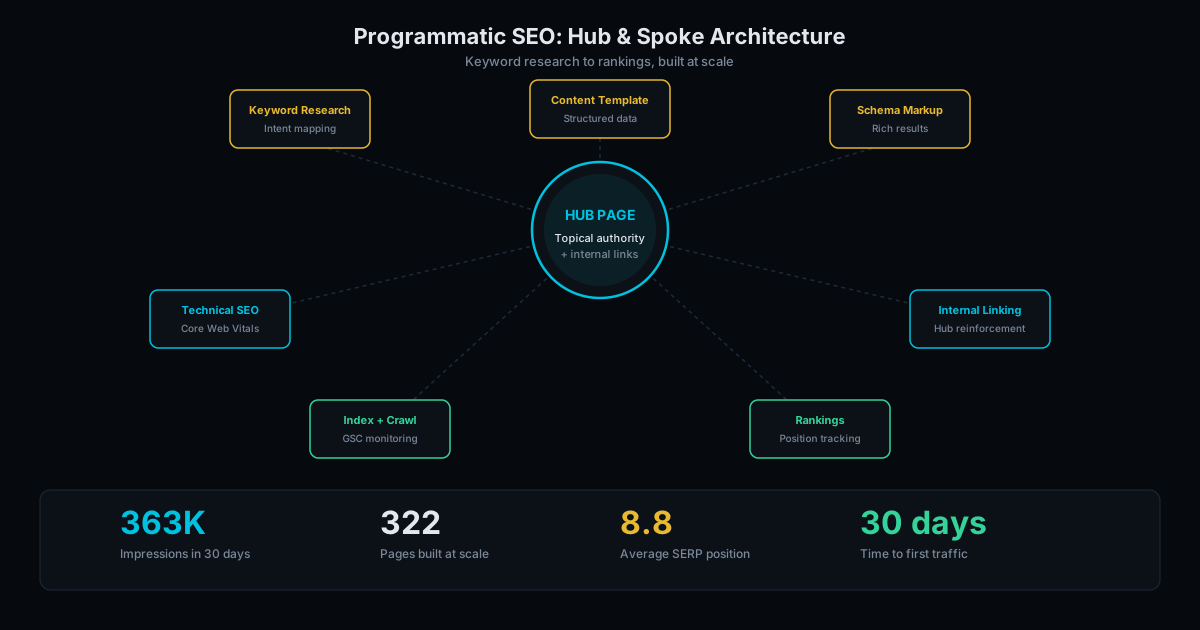
Build these pages using the hub-and-spoke model. Your city page is the hub. Each neighborhood is a spoke. This structure builds topical authority for your entire market area and helps Google understand your geographic coverage.
Build Your Real Estate Site
We build websites for real estate agents and teams that load fast, rank locally, and convert visitors into clients. No IDX bloat. 90+ PageSpeed. Neighborhood pages for local SEO. Lead capture for nurturing.
Real estate sites start at $3,000. See our pricing page for full details. Contact us or audit your current site to see what IDX is costing you in performance.
Frequently Asked Questions
Do I need IDX on my website?
Probably not. Buyers use Zillow and Redfin for listing search. Your website's job is to establish your expertise and capture leads. A fast site with neighborhood content and easy contact converts better than a slow site with an IDX widget that replicates Zillow poorly.
How do I compete with Zillow in search?
You cannot outrank Zillow for 'homes for sale in [city].' But you can outrank them for specific neighborhoods, market insights, and agent-focused queries. 'Best neighborhoods in [city] for families' or '[neighborhood] real estate market report' are queries Zillow does not target well.
What about broker requirements for IDX?
Some brokerages require IDX on agent websites. If required, use a lightweight IDX solution that loads on a dedicated search page rather than sitewide. Keep the IDX widget off your homepage and landing pages to maintain performance where it matters most.
Ready to Fill Your Next Event?
We build the page, set up the pixels, and run the ads. You run the event.