
How to Get 90+ PageSpeed Score (And Why Google Cares)
By Rome Thorndike
Why 90+ Matters
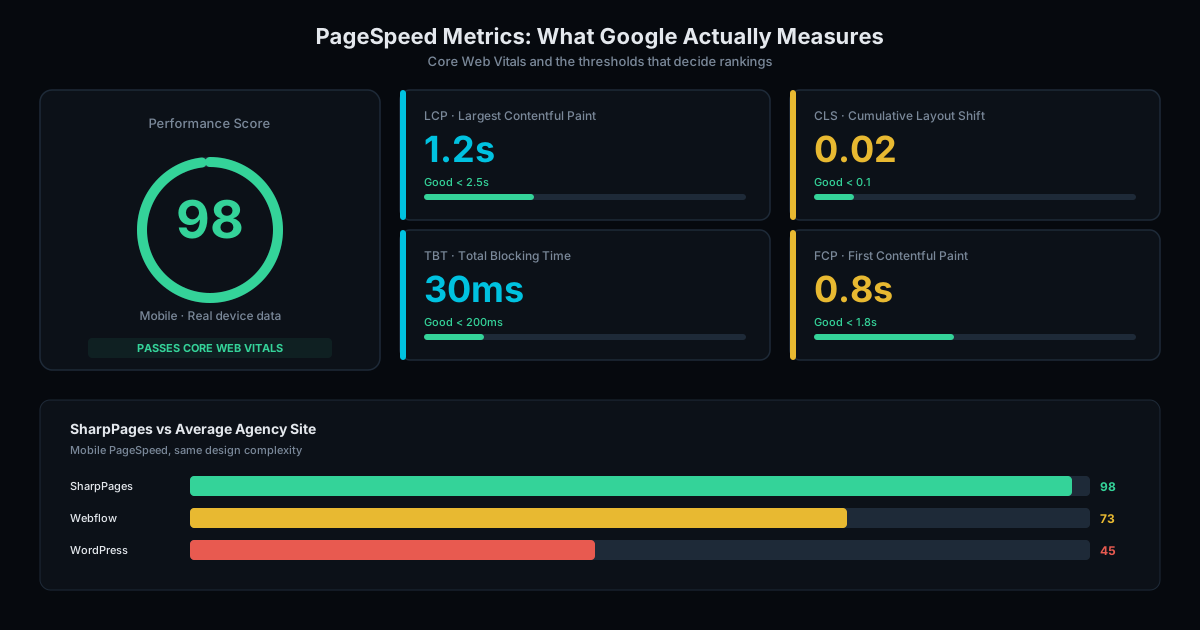
Google PageSpeed Insights scores your site from 0 to 100 on mobile performance. 90+ is green (good). 50-89 is orange (needs improvement). Below 50 is red (poor).
Google uses Core Web Vitals (derived from the same metrics PageSpeed measures) as a ranking factor. Sites with good scores get a ranking boost. In competitive search categories, that boost separates page 1 from page 2.
Speed also affects conversions. According to Google's performance research, 53% of mobile visits are abandoned if the page takes over 3 seconds to load. Every second of load time costs roughly 7% in conversions. A site generating $50,000/year in leads could gain $3,500 by cutting 1 second of load time.
The Quick Wins
These fixes improve any site regardless of platform:
Optimize images. Convert to WebP format. Size images to the container (not 4000px for a 400px slot). Add width and height attributes. Lazy-load below-the-fold images with loading="lazy". This alone can improve scores by 10 to 30 points.
Defer JavaScript. Add defer or async to script tags that are not critical for initial render. Move analytics, chat widgets, and social scripts below the fold or load them after page interaction.
Minify CSS and JS. Remove whitespace, comments, and unused code. Tools like cssnano and terser handle this automatically. Reduction of 30-50% in file size is typical.
Enable compression. Gzip or Brotli compression on the server reduces transfer sizes by 60-80%. Most hosting providers support this: it may just need to be enabled.
Advanced Optimizations
Once you have handled the quick wins, these techniques push scores from 80 into the 90s:
Eliminate render-blocking CSS. Inline the critical CSS (styles needed for above-the-fold content) directly in the HTML <head>. Load the remaining CSS asynchronously with <link rel="preload" as="style">. This lets the browser render the visible page without waiting for the full stylesheet.
Use resource hints. <link rel="preconnect"> for third-party domains you know you will need (Google Fonts, analytics, CDNs). <link rel="preload"> for critical fonts and hero images. These hints save 100-300ms per resource by starting connections before the browser discovers them in the HTML.
Implement responsive images. Use srcset and sizes attributes to serve different image dimensions to different devices. A phone screen does not need a 1920px image. Serving a 480px image instead reduces transfer size by 75%.
Remove unused CSS. Page builders and frameworks ship thousands of CSS rules. Most pages use 10-20% of them. Tools like PurgeCSS remove unused rules during the build process. We have seen CSS files drop from 200KB to 15KB after purging. The MDN Web Performance guide covers these techniques in depth.
The Platform Ceiling
Quick wins get you to 70 or 80. Breaking through to 90+ depends on your platform.
WordPress: Maximum realistic score with aggressive optimization: 75-80. The PHP execution, database queries, and plugin overhead set a floor that cannot be optimized away.
Webflow: Maximum realistic score: 80-85. Cleaner than WordPress but still ships framework JavaScript on every page. See our Webflow vs static HTML comparison for the full benchmark data.
Squarespace: Maximum realistic score: 60-65. The platform controls the rendering pipeline. You cannot remove Squarespace's own scripts and styles.
Static HTML: Achievable score: 90-99. No framework, no runtime, no overhead. The score depends entirely on your own code and assets.
If your platform has a ceiling below your target score, optimization will not get you there. You need a different architecture. Our PageSpeed article explains why most agency-built sites hit this ceiling.
How to Diagnose Your Score
Run your site through PageSpeed Insights and read the diagnostics section, not just the score. PageSpeed tells you exactly what is slowing your page down, ordered by impact.
The key metrics to focus on:
- LCP (Largest Contentful Paint): How long until the biggest visible element loads. Target: under 2.5 seconds. Fix: optimize the hero image or heading font that triggers LCP.
- TBT (Total Blocking Time): How long JavaScript blocks the main thread. Target: under 200ms. Fix: defer non-critical scripts, reduce third-party JavaScript.
- CLS (Cumulative Layout Shift): How much the page layout jumps during loading. Target: under 0.1. Fix: add width/height to images, reserve space for ads and embeds.
Run the test 3 times and take the median score. PageSpeed results vary by 3-5 points between tests due to server conditions. If your score swings by more than 10 points, a third-party script is loading unpredictably.
For deeper analysis, check the Web Vitals documentation to understand what each metric measures and why Google chose these specific thresholds.
Getting to 90+
To consistently score 90+ on mobile, you need:
- Static HTML architecture. Pre-built pages served from a CDN. No server-side rendering, no database.
- One CSS file under 30KB. No CSS frameworks, no unused styles.
- Minimal JavaScript. Under 10KB total. Only what is needed (mobile nav, form validation).
- Optimized images with responsive srcset. Serve different sizes to different devices.
- Preloaded critical assets. Fonts and above-the-fold images loaded with
<link rel="preload">.
Every site we build at SharpPages scores 90+ on mobile. It is not optional: it is a deliverable. Start with a free audit to see your current score, or explore our web design service for a site built for speed from the ground up. Fixes for existing sites start at $1,000. See our pricing page for all options or get in touch.
Frequently Asked Questions
Is desktop or mobile PageSpeed more important?
Mobile. Google uses mobile-first indexing. Mobile scores are typically 20-40 points lower than desktop. If your mobile score is 90+, your desktop score is almost certainly higher.
Does PageSpeed score fluctuate?
Yes, by 3-5 points between tests due to server load and network conditions. Run the test 3 times and take the median. If your score swings by more than 10 points, there is an inconsistency in your page (e.g., third-party scripts loading unpredictably).
Can a site score 100?
Technically yes, but 95-99 is the practical ceiling for sites with any images, fonts, or JavaScript. Scoring 100 requires an extremely minimal page. Aiming for 90+ is the right target, as the ranking benefit plateaus above 90.
Ready to Fill Your Next Event?
We build the page, set up the pixels, and run the ads. You run the event.