
Franchise Network SEO 2026: One Codebase, 50 Locations
By Rome Thorndike
The Problem with Franchise Sites
Most franchise networks we audit fall into one of two failure modes. The first is one bloated WordPress install where every location is a child page under /locations/, all sharing the same theme, the same plugins, and the same poorly-cached map widget. The second is fifty separate WordPress installs, one per franchisee, each on a different host, each running a different theme, each ranking against the others.
Both lose. The first fails because the architecture cannot scale: page templates are rigid, location pages get pruned by Google as thin content, and the master site eats a 60-PageSpeed score. The second fails because authority is fragmented across fifty domains, none of which has enough content or backlinks to rank for anything competitive.
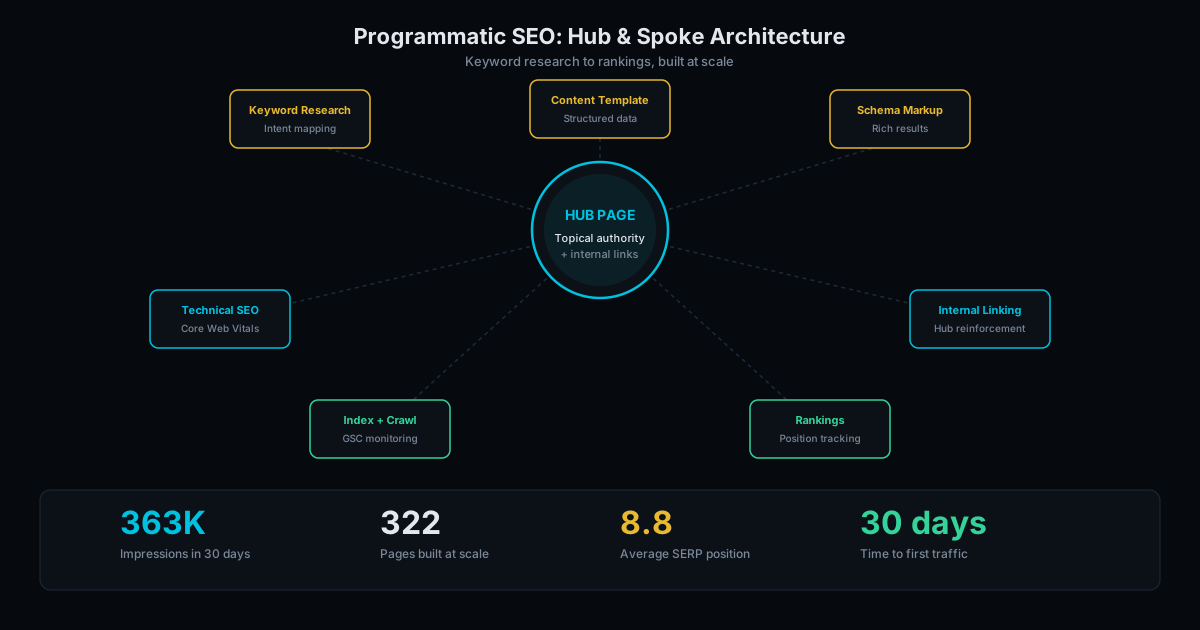
There is a third path. One codebase, one domain, templated location pages with unique local content, hub-and-spoke internal linking, and per-location LocalBusiness schema. We have built this for several multi-location operators and the ranking lift is consistent. Here is how it works.
Hub and Spoke, the Real Version
The hub is your main brand site at the root domain. It carries the core service pages, the about page, the brand story, and the national-level keyword targeting. The spokes are location pages, one per franchisee, each at /locations/city-state/ or /city-state/ depending on URL strategy.
What makes this work is the linking pattern. The hub links down to every spoke from a master locations index. Each spoke links up to the hub from its breadcrumbs and from a "back to all locations" link. Spokes do NOT link to other spokes directly. That cross-linking pattern fragments link equity and confuses Google about which page should rank for which city. Read our deeper take on hub-and-spoke topical authority for the underlying mechanics.
The other thing that makes this work: every spoke must have unique content. Not "spun" content. Not "AI-rewritten" content. Real local content about that location's hours, address, parking, neighborhood, staff, photos, and customer testimonials. Google's helpful content system penalizes templated location pages that differ only by city name. We have seen networks lose 70% of their location-page traffic in a single update for exactly this reason.
Schema Per Location, Done Right
Every location page needs its own LocalBusiness JSON-LD block. The schema should include the legal name, the address fields (streetAddress, addressLocality, addressRegion, postalCode, addressCountry), the phone number formatted as a tel: link, the geo coordinates, the opening hours, the price range, and an aggregateRating if you have reviews.
Common mistakes: copying the parent brand's schema to every location (Google reads through this), inconsistent NAP (name/address/phone) across schema and visible page text (this triggers a manual review), and omitting the @id field that links the location to the parent organization. If you have a corporate brand and individual franchisees, the schema should reflect that hierarchy with @id references between Organization and LocalBusiness entities.
For service-area businesses (mobile services like cleaning, plumbing, dog walking), use the AreaServed property with the cities or zip codes served. For brick-and-mortar locations, use the address fields and let geo coordinates handle the rest. We cover the broader schema landscape in our schema markup guide for small business.
Programmatic Templates That Do Not Look Programmatic
The trick to scaling location pages is templating without flattening. A good location template has 6 to 10 sections: hero with location-specific photo, address and hours, services offered at this location, meet the team, customer reviews from this location, FAQs that reference the city or neighborhood, directions and parking, contact form scoped to this location.
Each section pulls from a structured data file (CSV, JSON, database) with per-location fields. The team section pulls staff photos and bios for that franchisee. The reviews section pulls only reviews for that location, not the corporate average. The FAQ section can include shared questions (with shared answers) plus 2 or 3 location-specific questions. The shared content is fine. The local content is what makes the page rank.
We build these in Python or Node, generate static HTML at build time, and deploy through GitHub Pages or Cloudflare. No CMS. No database queries at runtime. Page generation takes 30 seconds for 100 locations. Deploys take 90 seconds total. Recrawls happen in hours, not days. Our multi-location SEO playbook walks through the build process step by step.
Internal Linking at Scale
The internal linking strategy for franchise networks is simple in principle, painful to execute manually, trivial to execute programmatically. Three rules:
Rule one: every location page links to the parent brand page, the master locations index, and 3 to 5 "nearby locations" within 50 miles. Nearby links signal to Google that this is a regional network and let users find the closest location if the one they landed on is too far. Build nearby suggestions from geo coordinates at compile time.
Rule two: every service page links to the locations that offer that service. If you offer six services and have fifty locations, but only thirty locations offer service four, then only those thirty get linked from service four's page. This gives Google a clear "which location ranks for which service in which city" signal.
Rule three: every blog post links to two or three relevant location pages and at least one service page. Editorial links from in-context content carry more weight than navigation links.
What Breaks at Scale
Franchise networks scale on the build but break on the operations. The most common failure mode we see: a franchisee buys local advertising, the agency builds them a separate landing page on a separate domain, that domain ranks alongside the master domain, and now you have two pages competing for the same query. Cannibalization kills both.
Set policy upfront. Franchisees cannot run separate websites. Local ads must point to the master domain's location page. Local Google Business Profiles must link to the master domain location URL, not a third-party landing page. If a franchisee needs more control over their page (their own gallery, their own offers), build that into the template, do not branch the codebase.
The other thing that breaks: location data drift. A franchisee updates their hours, tells corporate three months later, the schema goes stale, Google starts showing wrong hours in the knowledge panel. Build a self-serve form for franchisees to update their data. Validate changes through a corporate review queue. Push approved changes through the build pipeline weekly. The discipline is mundane and matters a lot. Our franchise multi-location service page goes into the operational details we ship with every build.
Where to Start
If you have an existing franchise site, the first move is an audit of your current location-page architecture: URL structure, content uniqueness, schema validity, internal linking, and PageSpeed scores per location. Most networks we audit have 3 to 5 fixable issues that account for 60 to 80% of the ranking gap to the leader in their category.
Run your domain through our free site audit for a baseline. Reach out through our contact page if you want a custom recommendation for a 20+ location rebuild. We have shipped this exact architecture for restaurant chains, service brands, and healthcare networks. See our work for examples.
Frequently Asked Questions
Should each franchise location have its own domain?
No. Separate domains fragment authority and force every location to start from zero. One master domain with per-location pages consolidates link equity and lets corporate-level backlinks lift every location simultaneously.
How unique does each location page need to be?
The address, hours, photos, staff, and at least 200 words of local content should be unique per page. Shared content like service descriptions can repeat across locations, but the page as a whole must read as a real description of that specific location, not a templated stub.
Can WordPress handle a 50-location franchise site?
It can, but performance suffers. Each location page hits the database, runs through the theme, and loads location-specific plugins. PageSpeed scores typically land in the 50-70 range. Static HTML builds the same network with 95+ scores and no runtime overhead.
How do we handle franchisee turnover?
Build a corporate-managed pipeline where new franchisees provide content through a form, the data flows into your build system, and the page generates on the next deploy. When a franchisee leaves, you 301 the location URL to the master locations index or the nearest open location. No orphan pages.
What about Google Business Profile for each location?
Every location needs its own verified GBP, owned by corporate or co-managed with the franchisee. The GBP website URL should point to the master domain location page. Consistent NAP between GBP, schema, and visible page text is non-negotiable for local rankings.
Ready to Fill Your Next Event?
We build the page, set up the pixels, and run the ads. You run the event.

Rome Thorndike
Rome Thorndike is the Founder & CEO of SharpPages, which builds event websites around a clear commercial goal: turning audience interest into registrations. He previously led marketing and revenue at Firmograph and held enterprise sales roles at Microsoft and Salesforce.
Connect on LinkedIn