
SEO for Real Estate Agents: Ranking for '[City] Homes for Sale'
By Rome Thorndike
The Reality of Real Estate SEO
Zillow, Realtor.com, and Redfin dominate "[city] homes for sale" searches. An individual agent website will not outrank them for broad city-level terms. That is the reality.
But there is a massive opportunity in searches they do not dominate: neighborhood-level queries, market insight queries, and hyper-local questions. "Homes for sale in [specific neighborhood]," "[neighborhood] vs [neighborhood]," "best neighborhoods in [city] for [criteria]." These are searches where a local expert with good content can outrank the portals.
Ahrefs data shows that neighborhood-level real estate queries have 70-80% less competition than city-level terms while converting at 2-3x higher rates. "Homes for sale in Mueller Austin" has a keyword difficulty of 15 compared to 85 for "Austin homes for sale." The neighborhood searcher is also further along in their decision: they already know which area they want. That makes them a better lead.
Neighborhood Pages
Create a dedicated page for each neighborhood in your market. Each page includes: neighborhood overview, market stats (median price, days on market, price trends), school information, amenities and lifestyle, your commentary as a local expert, and a CTA to connect.
This is a programmatic SEO opportunity. If you serve 30 neighborhoods, generate 30 pages from structured data. Each page targets "[neighborhood] real estate" and "[neighborhood] homes for sale."
Update market stats quarterly. Fresh data signals to Google that the content is current. Stale data from 2024 on a page about 2026 market conditions hurts credibility and rankings.
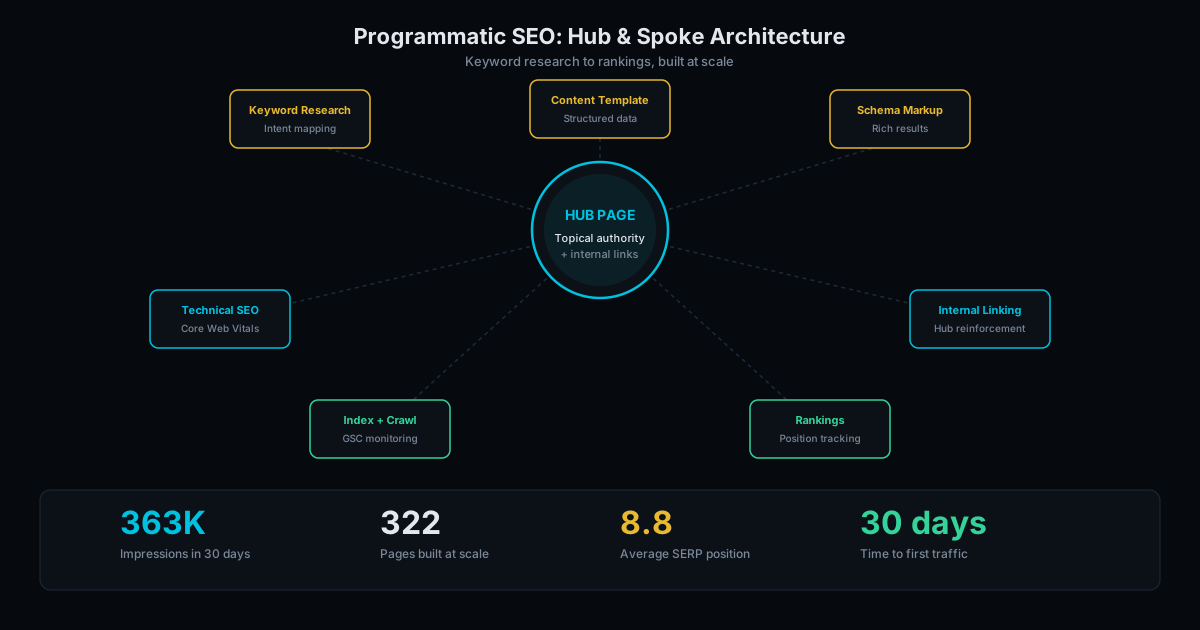
Structure your neighborhood pages using the hub-and-spoke model. The hub is your city-level page ("/areas/austin/"). The spokes are individual neighborhood pages ("/areas/austin/mueller/", "/areas/austin/east-side/"). The hub links to all spokes. Each spoke links back to the hub and to 2-3 related neighborhoods. This internal linking structure builds topical authority for your entire market.
Each neighborhood page should include 500-800 words of unique content. That sounds like a lot across 30 pages, but programmatic generation handles the data-driven portions (stats, school ratings, walkability scores). You add 2-3 paragraphs of expert commentary per neighborhood, and the rest is templated from structured data.
Content That Beats Portals
Zillow has listings. You have opinions, experience, and local knowledge. Content that beats portals:
- Market analysis: "Is [city] a buyer's or seller's market in 2026?" Portals have data but not analysis. Your expert interpretation of median price trends, inventory levels, and days-on-market changes is content Zillow will not publish.
- Neighborhood comparisons: "[Neighborhood A] vs [Neighborhood B] for families." Portals do not create comparison content. A page comparing school ratings, commute times, price per square foot, and walkability between two neighborhoods serves a specific buyer need that no portal addresses.
- Buyer guides: "First-time homebuyer guide for [city]." Localized with city-specific programs (down payment assistance, tax credits), average closing costs, property tax rates, and timeline expectations. Generic national guides cannot compete with local specifics.
- Community content: Best restaurants, parks, schools, events in each neighborhood. This is hyperlocal content portals cannot scale. You live in this market. Write about it from experience.
Publish one piece of local content per week. Within 6 months, you will have 25+ pages of hyper-local content that no portal can replicate. This content library becomes your organic traffic moat.
Technical SEO for Real Estate Sites
Neighborhood pages need proper technical SEO to rank. Follow Google's SEO starter guide and add these real-estate-specific elements:
- RealEstateAgent schema: Mark up your agent profile with Schema.org RealEstateAgent type. Include your name, brokerage, service area, and contact information.
- Place schema on neighborhood pages: Each neighborhood page should include Place schema with geo coordinates, containing city, and relevant area descriptions.
- FAQ schema: Add FAQ markup to neighborhood pages answering common questions like "What is the average home price in [neighborhood]?" and "What are the best schools near [neighborhood]?" This can earn featured snippet placement in search results.
- Breadcrumb navigation: Areas > [City] > [Neighborhood]. Implement BreadcrumbList schema so Google displays the hierarchy in search results.
Page speed matters for real estate. Buyers browsing on their phones at open houses or during commutes will not wait 4 seconds for your page to load. Target 90+ on PageSpeed. Learn how in our PageSpeed optimization guide.
Measuring Real Estate SEO Results
Real estate SEO takes 3-6 months to show results. Track these metrics to measure progress:
Rankings by neighborhood: Track your position for "[neighborhood] homes for sale" and "[neighborhood] real estate" for each page. Tools like Ahrefs or SEMrush can monitor 50+ keywords weekly. You should see movement within 60-90 days of publishing optimized neighborhood pages.
Organic traffic by page: Use Google Search Console to see which neighborhood pages drive the most impressions and clicks. Pages with high impressions but low clicks need better title tags and meta descriptions. Pages with low impressions need more content depth or backlinks.
Lead quality: Track which pages generate contact form submissions and phone calls. Neighborhood page leads typically convert to clients at 3-5x the rate of homepage leads because the visitor has already self-selected into a specific area. They are further along in their search.
Content freshness: Set quarterly reminders to update market stats on each neighborhood page. Track which pages have stale data (more than 4 months old) and prioritize updates. Google Search Console will show declining impressions on pages with outdated content, giving you a clear signal of which pages need attention first.
Build Your Real Estate SEO
We build real estate websites with neighborhood pages, market content, and local SEO. Programmatic generation scales neighborhood pages across your entire market. 90+ PageSpeed ensures visitors stay.
Neighborhood page generation: $3,000 to $10,000. Monthly SEO and content: $1,500 to $3,000. See pricing for full details. Contact us to build your local search presence.
Frequently Asked Questions
Can I outrank Zillow?
For broad terms like '[city] homes for sale,' no. For specific neighborhood terms, comparison content, and market analysis, yes. Zillow scales breadth. You scale depth. A page with expert analysis of a specific neighborhood outranks a Zillow listing page for that neighborhood's informational searches.
How many neighborhood pages do I need?
Create a page for each neighborhood you serve or want to serve. For most agents, this is 15-40 neighborhoods. Quality matters: each page needs unique content, not a name swap. Programmatic generation ensures consistency while data ensures uniqueness.
How often should I update market data?
Quarterly at minimum. Monthly is ideal if you can automate data collection. Google rewards fresh content, and prospects distrust stale market data. Automated build systems can pull updated data and regenerate pages with minimal manual effort.
Ready to Fill Your Next Event?
We build the page, set up the pixels, and run the ads. You run the event.