
Pharma Field Marketing: Website Strategy
By Rome Thorndike
The Pharma Website Challenge
Pharma field marketing teams need websites for HCP events, speaker programs, and regional campaigns. The challenge: these sites must be compliant (MLR-reviewed), fast to launch (weeks, not months), and easy for non-technical field teams to share and use.
Enterprise web platforms (Veeva, IQVIA) solve compliance but add 6-12 weeks of build time and five-figure costs per site. For a field team running 20+ events per year, that timeline and cost do not scale.
Static sites solve the speed and cost problem while maintaining compliance. The site is a set of pre-built HTML files: no CMS to misconfigure, no database to breach, no dynamic content that could drift from approved copy.
Compliance by Architecture
Static sites are inherently compliance-friendly:
- Immutable content. Once built and MLR-approved, the content cannot change unless someone rebuilds and redeploys. No risk of a field rep editing live content through a CMS.
- No database or user data. Registration forms submit to external HIPAA-compliant services. The site itself stores nothing. No PHI on your servers.
- Version control. Every change is tracked in Git. You have a complete audit trail of what was published and when. If MLR needs to review what was live on a specific date, you can show them the exact version.
- Fast MLR turnaround. Review a folder of HTML files, not a complex CMS build. The content is what you see: no hidden dynamic elements or database-driven text.
FDA Digital Marketing Considerations
The FDA has issued guidance on digital marketing for pharmaceutical products that applies directly to field marketing websites:
- Fair balance. Every page that mentions product benefits must include risk information. On event sites, this means ISI (Important Safety Information) must be accessible from any page that references the product.
- Character-limited communications. If your event page is shared via text or social media, the preview snippet must include the product name and a link to full risk information.
- Corrective information. If an HCP event site includes presentation slides or materials, those assets need the same regulatory review as printed materials.
- Adverse event reporting. Event sites with contact forms or chat must have a process for handling adverse event reports submitted through digital channels.
Static architecture helps here: once MLR approves the fair balance content and its placement, it cannot shift or disappear through CMS errors. The approved version is the deployed version.
Multi-Event Scale
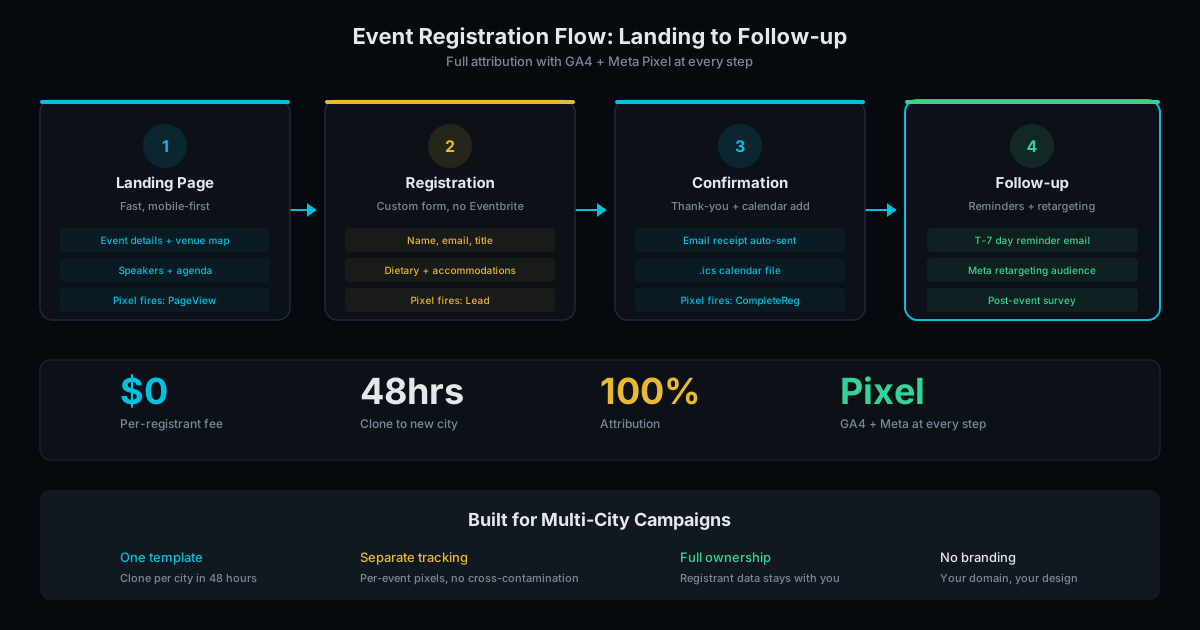
The same clone strategy we use for corporate events works for pharma speaker programs and field events. Build one MLR-approved template, then clone for each event with only the variables changed (date, venue, speaker).
Template approval is a one-time process. Each clone updates only pre-approved variable fields. This reduces MLR review time for subsequent events: they review variables, not the full site.
Each event page gets its own URL, its own tracking (GA4 + Meta Pixel), and its own registration data. Roll up reporting across events to measure field marketing effectiveness at the national level.
The economics improve at scale. The first event template costs $2,000 to $4,000 including design and MLR preparation. Each subsequent clone costs $500 to $1,000. A team running 30 events per year pays a fraction of what enterprise platforms charge per site.
Rep Experience and Adoption
The best compliant website is useless if field reps do not share it. Rep adoption depends on three factors:
Speed. When a rep texts an HCP a link to the event page, it needs to load instantly. A 90+ PageSpeed score means the page loads in under 1 second. An HCP opening a slow-loading link on their phone between patients will close it. Read more about common causes of slow websites and how to avoid them.
Mobile design. Reps share links via text. HCPs open them on phones. The event page must be mobile-first: clear date and location, speaker credentials, one-tap registration. No pinching, no horizontal scrolling, no tiny text.
Simple URLs. Give reps clean, memorable URLs they can share verbally: yourbrand.com/events/boston-march not yourbrand.com/events?id=38291®ion=ne. Clean URLs also track better in analytics.
Get Started
We build websites for pharma field marketing teams. Static architecture for compliance. Clone workflows for scale. 90+ PageSpeed scores for rep credibility when sharing links with HCPs.
View our pricing for pharma event website packages. First event template: $2,000 to $4,000. Event clones: $500 to $1,000 each. Contact us to discuss your field marketing website needs.
Frequently Asked Questions
Can static sites pass MLR review?
Yes. Static sites are simpler for MLR to review because the content is fixed HTML: what you see is what is published. No dynamic content, no CMS-generated text, no risk of unapproved content appearing through database changes.
How do you handle ISI and PI requirements?
Important Safety Information and Prescribing Information are included as required by the site's purpose. For HCP event sites, ISI can be included on-page or linked to the approved PI document. The approach is determined during MLR review.
What about Veeva Vault integration?
Static sites exist independently of Veeva Vault. The approved HTML files and assets can be uploaded to Vault as digital assets for tracking. The build process is external, which gives field marketing teams faster turnaround than building within Vault's content management system.
Ready to Fill Your Next Event?
We build the page, set up the pixels, and run the ads. You run the event.