
Event Registration Page Examples That Convert
By Rome Thorndike
What High-Converting Pages Have in Common
We have built registration pages for conferences, corporate events, and multi-city tours. The pages that convert at 15%+ (vs the 3-5% industry average) share five elements:
- One clear CTA above the fold. "Register Now" or "Reserve Your Spot." Not "Learn More." The action is the first thing visible.
- Social proof near the CTA. Attendee count, company logos, speaker names, or a testimonial. Something that validates the event before the visitor scrolls.
- Minimal form fields. Name and email. Maybe company name. Every additional field reduces conversion by 5-10%. Collect details in a confirmation email, not the registration form.
- Urgency without fake scarcity. Early bird pricing with a real deadline. "200 of 500 seats filled." Remaining speaker slots. Real numbers, not manufactured urgency.
- Fast load time. Registration pages must load in under 2 seconds on mobile. A 3-second page loses 53% of mobile visitors before they see the form. See our Core Web Vitals guide for performance benchmarks.
The Page Structure That Works
Hero section: Event name, date, location (or "Virtual"), one-sentence value proposition, register button. No carousel. No video background. Clean and fast.
What you will learn/get section: 3 to 5 bullet points of concrete outcomes. "Walk away with a 90-day marketing plan" not "Network with industry leaders." Specific beats vague.
Speaker/agenda section: Photos, names, titles, and one sentence about what each speaker covers. If the agenda is not finalized, show confirmed speakers and "more coming soon."
Logistics section: Date, time, location/platform, parking/access info. Answer every logistical question so the only remaining action is to register.
Final CTA: Repeat the registration form or button. Visitors who scroll to the bottom are warm. Make it easy to convert without scrolling back up.
Registration Page Examples by Event Type
Corporate conference (500+ attendees). A B2B SaaS company ran a 3-city conference tour. Each page featured a 2-field form (name, email), a 90-second sizzle reel from the prior year, and a speaker grid with headshots and company logos. Conversion rate: 18.4%. The key: company logos of past attendees served as social proof, and the form asked for nothing beyond name and email. Job title and company were collected in the confirmation email flow.
Workshop or masterclass (50-200 attendees). A consulting firm promoted a half-day workshop. The page led with the specific outcome ("Leave with a documented 90-day growth plan"), listed the 4 modules covered, and included 3 short video testimonials from past attendees. Conversion rate: 22%. The testimonials did the selling; the page just had to stay out of the way.
Webinar (unlimited virtual seats). A fintech company ran monthly webinars. The page had a headline, 3 bullet points of what attendees would learn, speaker bio, and a 1-field form (email only, since they were all existing contacts). Conversion rate: 31%. Fewer fields and lower commitment (virtual, free, 45 minutes) drove the high conversion rate.
In every case, pages that loaded in under 1.5 seconds on mobile converted 2x better than pages that loaded in 3+ seconds. Speed is not a nice-to-have for registration pages. It is a conversion factor.
Technical Setup for Tracking
Registration is meaningless if you cannot track where registrants came from. Every event page needs:
- GA4 event tracking. Fire a conversion event when the form submits. Tag it with the event name and source for attribution. See Google's GA4 setup guide for implementation steps.
- Meta Pixel. Install it even if you are not running Facebook Ads yet. The pixel collects visitor data you can use for retargeting campaigns later.
- UTM parameters. Use UTM-tagged links in emails, social posts, and ads so GA4 shows which channel drove each registration.
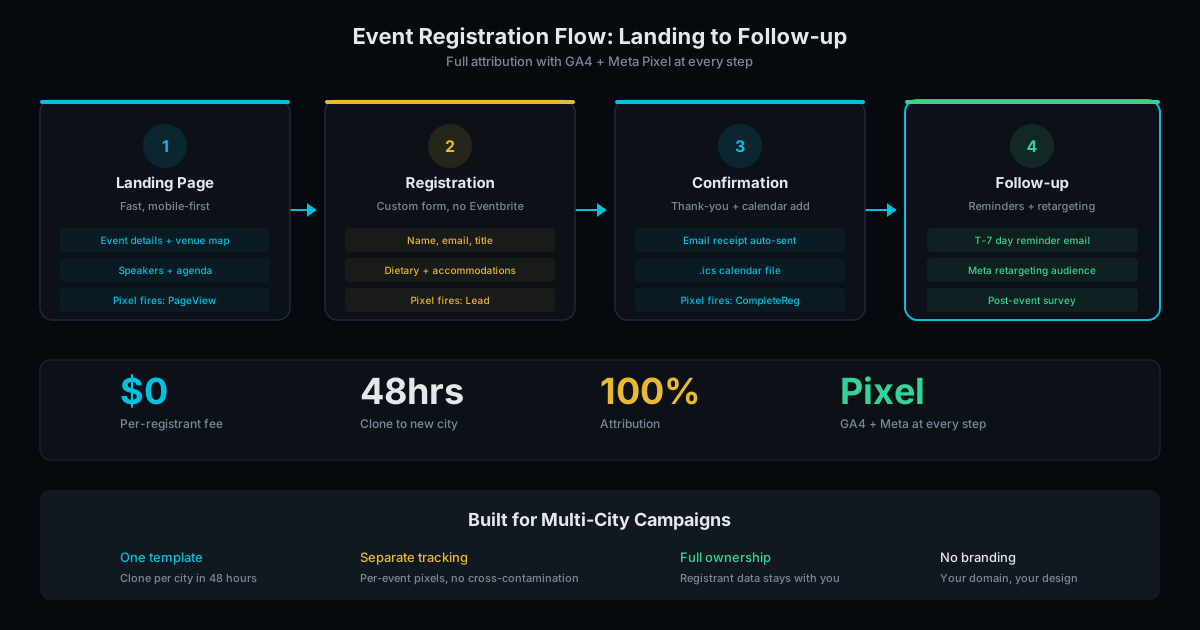
- Thank-you page. Redirect to a dedicated thank-you page after registration. This page is your conversion trigger for both GA4 and Meta Pixel. It also confirms the registration and sets expectations (confirmation email, calendar invite).
Post-Registration: The Confirmation Flow
The thank-you page and confirmation email are part of the conversion experience. A weak confirmation flow increases no-show rates.
Thank-you page: Confirm the registration, display event details (date, time, location), and include an "Add to Calendar" button (.ics file download or Google Calendar link). Pages with calendar integration see 15-20% lower no-show rates.
Confirmation email: Send within 60 seconds. Include the same event details, a calendar attachment, and any pre-event materials. This is also where you collect additional information (job title, company, dietary restrictions) without hurting the initial conversion rate.
Reminder sequence: Send reminders at 7 days, 1 day, and 1 hour before the event. Each reminder should include the event link or address, parking information, and a "forward to a colleague" CTA. Reminder sequences reduce no-show rates from 30-40% to 10-15% for free events.
Build Your Registration Page
Our event registration service builds custom pages with GA4 tracking, Meta Pixel, responsive design, and 90+ PageSpeed scores. No per-registrant fees (unlike Eventbrite or Splash). No platform lock-in. You own the page and all the data.
First event page: $2,000 to $4,000. Clone pages for multi-city events: $500 to $1,000 per city with 48-hour turnaround. Check our pricing page for full details, or get started.
Frequently Asked Questions
What conversion rate should I expect?
Industry average for event registration pages is 3-5%. Well-optimized pages with the structure above convert at 10-20%. The biggest factors are form length (fewer fields = higher conversion) and page speed (under 2 seconds on mobile).
Should I use Eventbrite or a custom page?
Eventbrite charges per registrant and limits your branding and tracking. Custom pages have no per-registrant fees, full branding control, and complete analytics ownership. For corporate or recurring events, custom pages pay for themselves quickly.
How do I handle payment on a registration page?
For paid events, integrate Stripe Checkout. The attendee clicks Register, enters payment on Stripe's hosted page, and redirects to your thank-you page. No payment processing on your server. No PCI compliance burden.
Ready to Fill Your Next Event?
We build the page, set up the pixels, and run the ads. You run the event.