
Conference Organizer Tech Stack Comparison
By Rome Thorndike
The Five Real Options
Conference organizers face a tighter choice than they realize. Most of the dozens of "event platforms" advertised online collapse into five categories: Eventbrite (low-cost ticketing), Splash (branded experiences for marketers), Bizzabo (mid-market events), Cvent (enterprise events), and custom-built sites. We have shipped or worked alongside all five. Here is the honest tradeoff matrix.
Eventbrite
Eventbrite is a ticketing platform with a public event marketplace attached. It costs 3.7% + $1.79 per paid ticket plus a 2.9% payment processing fee, which on a $200 ticket runs $14 to $15 per registration. Free events are free to host. The pricing scales linearly with ticket volume, which becomes painful fast.
What Eventbrite is good at: discovery for consumer events. The marketplace drives meaningful walk-in traffic for fitness classes, local meetups, and ticketed gatherings under 500 attendees. If your event lives or dies on Eventbrite browse traffic, you stay on Eventbrite.
What it is bad at: branded experiences, mobile speed, conversion. The pages are slow (mobile PageSpeed typically 35-50), the form is heavy, and the URL lives on eventbrite.com which kills SEO equity for your own domain. Conversion rates on cold paid traffic to Eventbrite pages run 30 to 50% below the same offer on a custom page. We documented this gap in Eventbrite vs custom event sites.
Right fit: under 500 attendees, no recurring conference, low marketing budget, dependent on marketplace discovery.
Splash
Splash sits in the "events as brand marketing" segment. Pricing starts around $12,000/year for the Pro plan, with most real-world deployments landing in the $20,000 to $40,000 range once you add seats and add-ons. Splash bills annually, not per event.
What Splash is good at: brand-controlled event pages, polished design templates, email sequences, integration with Marketo and Salesforce. The platform was built for marketing teams running 20+ events per year with consistent branding. Field marketing teams in tech love Splash for dinner programs and roadshows.
What it is bad at: SEO, page speed, and unique conversion optimization. Splash pages are templated; you can adjust styling but not architecture. Mobile PageSpeed lands in the 50-70 range. Custom JavaScript or unique landing page experiments require workarounds. If your event marketing motion is mostly invitation-driven (you know who to invite, you have their email), Splash works. If you need to acquire cold attendees at scale, the page speed and conversion ceiling hurts.
Right fit: 20+ events/year, marketing team with email lists, brand-driven invitations rather than discovery, $30K+ annual platform budget.
Bizzabo
Bizzabo is positioned for mid-market hybrid and in-person events. Pricing is opaque (custom quotes only) but typically runs $15,000 to $50,000 per event for full deployment, including mobile app, session management, and onsite check-in. They also offer annual contracts in the $50K to $150K range for multi-event customers.
What Bizzabo is good at: hybrid events where you need streaming, breakout sessions, attendee networking features, and an event app. The mobile app is decent. Speaker management and session scheduling are first-class features. Onsite check-in and badge printing work without drama.
What it is bad at: marketing pages and SEO. The registration page is a generic template that lives on a Bizzabo subdomain or a thinly branded section of your site. Page speed runs 40-60 mobile. If your event lives on the registration page (most do for cold acquisition), the platform fights you.
Common pattern we see: organizers run Bizzabo for the event itself (logistics, app, check-in) but build a custom marketing site separately for top-of-funnel acquisition. The custom site captures leads, sends them into Bizzabo for the actual registration and payment. This is more expensive but materially better conversion.
Right fit: mid-market hybrid events with session complexity, attendee networking needs, and dedicated event ops budget.
Cvent
Cvent is the enterprise option. Pricing is firmly six figures: $75,000/year minimum is the realistic entry point, with large customers spending $300K to $1M+ across modules. The platform covers everything from venue sourcing to attendee marketing to post-event analytics, plus its hospitality cloud (RFP marketplace) for hotel sourcing.
What Cvent is good at: scale, integrations, compliance. If you run 50+ events per year across business units, Cvent's reporting, approval workflows, and integration with SAP/Workday/HubSpot pays for itself in operational savings. Procurement and finance love it. SOC2/GDPR compliance is straightforward.
What it is bad at: agility and modern UX. The marketing pages look like 2018. Page speed is similar to Bizzabo. Building a one-off branded landing page for a specific campaign requires more friction than the campaign justifies. Most enterprise Cvent customers we work with use Cvent for the backbone and supplement with custom landing pages for individual campaigns.
Right fit: large enterprises, 50+ events/year, multiple business units, compliance and procurement constraints.
Custom Built
Custom event sites mean static HTML or a lightweight CMS purpose-built for the event. We build these regularly at SharpPages. Costs run $2,500 to $8,000 for a single-event landing page with payment integration, $10,000 to $25,000 for a multi-session conference site with speaker pages and an agenda.
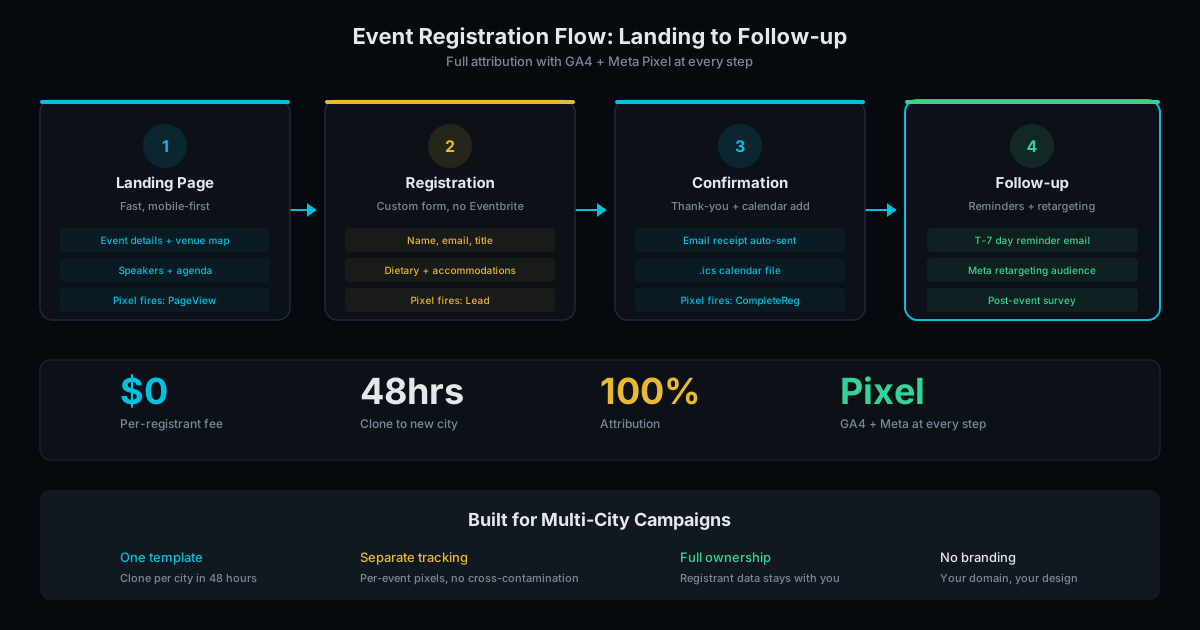
What custom is good at: page speed, conversion, brand, SEO. Mobile PageSpeed routinely hits 95+. Pages live on your domain, build domain authority over time, and rank for recurring event queries. Forms are tuned for your specific audience. Tracking is precise (Meta Pixel and GA4 server-side conversions, full attribution). For recurring events, the page from year one becomes a marketing asset that compounds across years two and three.
What custom is bad at: heavy logistics. If you need an attendee mobile app, session management for 50+ tracks, in-person badge printing, or complex hybrid streaming, custom is not the right tool. Pair custom with a logistics platform (often Bizzabo or RegFox) for those needs.
Common combination: SharpPages-built marketing pages for top-of-funnel and registration, Stripe for payment, RegFox or Bizzabo for ticketing logistics. The marketing site is fast and converts. The logistics platform handles what it is good at. Both layers stay in their lane. Our conference organizers page covers the build approach in detail, and Eventbrite alternatives for corporate registration covers the swap decision.
How to Pick
Decide by scale and motion. Under 500 attendees on consumer events with low budget: Eventbrite. Marketing-driven events at scale: Splash if you have $30K/year. Hybrid events with logistics complexity: Bizzabo. Enterprise with multi-unit scale: Cvent. Single signature events where the page is the marketing asset: custom.
The most common mistake we see: organizers buy Bizzabo or Cvent for the logistics, then accept the bad marketing pages and lose 20 to 40% of conversion. Custom landing pages plus a logistics platform almost always beats either one alone. Talk to us at SharpPages if that hybrid model fits your event.
Frequently Asked Questions
Is Eventbrite cheaper than a custom event site?
Only if you have low ticket volume. Eventbrite fees of 3.7% + $1.79 + payment processing add up to $14-15 per $200 ticket. At 500 tickets that is $7,500 in fees. A custom site costs $2,500-8,000 once and converts 30-50% better on cold traffic.
When is Splash worth $30K/year?
When you run 20+ marketing-driven events per year with consistent branding and your team prioritizes design polish over conversion experimentation. If you run fewer than 12 events per year, the per-event cost rarely justifies the platform.
Can I use Bizzabo just for the registration page?
You can, but the page speed and conversion will underperform a custom build. Most organizers we work with use Bizzabo for logistics (sessions, app, check-in) and a separate custom landing page for top-of-funnel marketing.
Does Cvent make sense for a 5-event-per-year organizer?
Almost never. Cvent's value is at scale (50+ events, multi-business-unit, compliance needs). At 5 events per year, the platform cost dwarfs the operational savings. A combination of Bizzabo or Splash plus custom landing pages is usually a better fit.
What is the best stack for a one-off signature conference?
Custom-built marketing site on your domain (for SEO and conversion), Stripe for payment, and a lightweight ticketing tool like RegFox for logistics. Total platform spend under $5,000. Page lives on your domain and builds equity for next year.
Ready to Fill Your Next Event?
We build the page, set up the pixels, and run the ads. You run the event.

Rome Thorndike
Rome Thorndike is the Founder & CEO of SharpPages, which builds event websites around a clear commercial goal: turning audience interest into registrations. He previously led marketing and revenue at Firmograph and held enterprise sales roles at Microsoft and Salesforce.
Connect on LinkedIn