
AI Overviews and Static Sites: Why Crisp HTML Wins
By Rome Thorndike
What AI Overviews Do
Google's AI Overviews scrape a handful of source pages, summarize them with Gemini, and put the summary above the standard ten blue links. For a lot of informational queries, this is now the first thing a searcher reads. If your page is one of the sources, you get cited. If your page is not one of the sources, you get scrolled past.
Getting cited is a different game from ranking #1. Google needs to fetch your page, render it, parse the content, extract a clean answer, and trust your domain enough to attribute the answer back. Every step of that pipeline rewards pages that are fast, structured, and easy to read. Pages that fight back at any step lose the citation slot to a competitor whose page does not.
We have watched this play out across the 30+ sites we maintain. Static HTML pages get pulled in. WordPress and Webflow pages get skipped, even when their content is better. The mechanics are worth understanding.
Crawl Speed Is the First Gate
Googlebot does not have infinite patience. Every site has a crawl budget. When the bot hits a slow page, three things happen. The fetch eats more of the budget, the page may be deferred to a later render queue, and the AI Overviews subsystem may decide your page is too expensive to use as a source for this query.
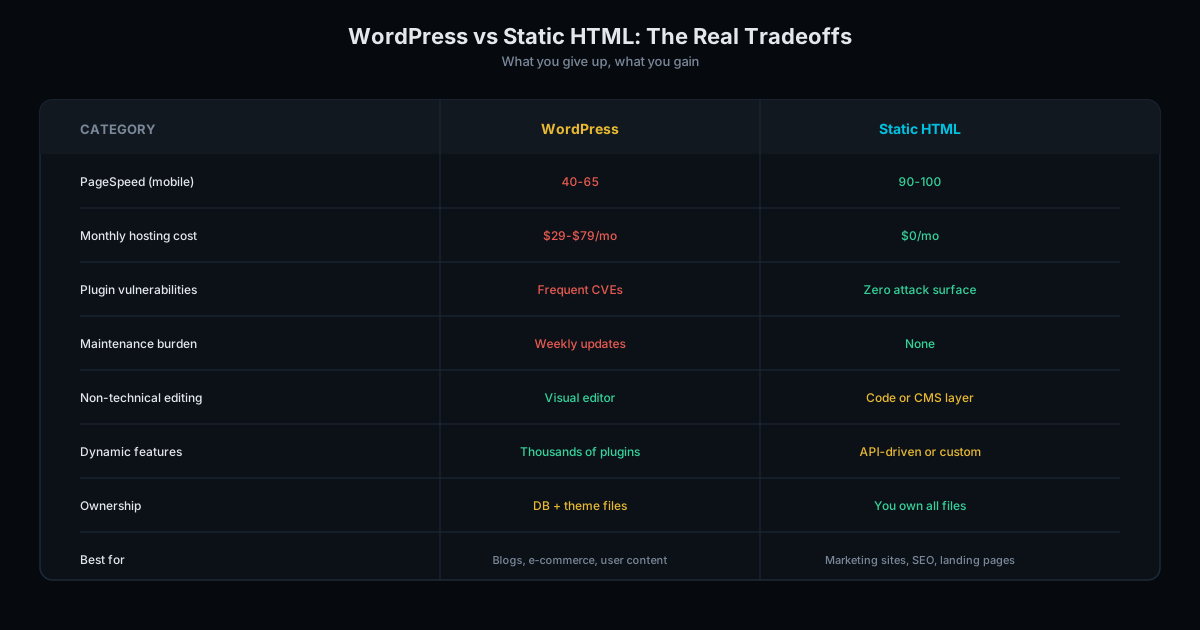
WordPress sites with 20+ plugins routinely take 1.5 to 4 seconds to serve raw HTML. Webflow CMS pages take 600ms to 1.2s under load. A well-built static page serves HTML in under 100ms from a CDN edge. That gap compounds across millions of bot fetches per day.
The result: static sites get crawled more often, get recrawled faster when content changes, and get included in time-sensitive AI Overview answers where freshness matters. If your event date changes, your pricing changes, or your product launches, a static site is back in the index within hours. A WordPress site might take a week.
Render Fidelity
Google's AI Overviews subsystem reads the rendered DOM, not the raw HTML response. For most pages that distinction does not matter. For pages that hydrate client-side with React, Vue, or Webflow's runtime, it matters a lot.
When Googlebot renders a JavaScript-heavy page, it runs Chrome headless, waits for hydration, and then snapshots the DOM. If hydration takes too long, fails, or depends on a third-party script that is rate-limited, the snapshot is incomplete. The AI Overviews subsystem then sees a partial page and either skips it or pulls a garbled excerpt.
Static HTML pages have no hydration step. The DOM at fetch time is the DOM at render time. Whatever you wrote in the source file is what Google reads. No race conditions, no failed script loads, no missing content. That reliability is why we recommend static HTML over dynamic platforms for content where ranking matters.
Structured Data, Live and Correct
AI Overviews lean heavily on structured data to extract clean answers. FAQPage schema, HowTo schema, Article schema, Product schema, and BreadcrumbList all signal what the page is and what the key entities are. Google's extraction model uses these signals as ground truth when the prose is ambiguous.
On WordPress, structured data is typically generated by a plugin (Yoast, Rank Math, Schema Pro) at render time. If the plugin is misconfigured, outdated, or conflicting with another plugin, the schema breaks silently. We have audited WordPress sites where 40% of pages had invalid JSON-LD and the owner had no idea.
On a static site, schema is part of the page source. It is version controlled. You can grep for it. You can validate every page in CI before deploy. When schema is broken, you know immediately. When schema is correct, it stays correct until you change it.
Content Density Matters More Now
AI Overviews favor pages that answer the query densely. A 500-word page with the answer in the second paragraph beats a 3,000-word page where the answer is buried under three product upsells and a video embed. WordPress themes love to pad pages with related posts widgets, author boxes, social share bars, comment sections, and newsletter signups. All of that dilutes the content-to-chrome ratio that AI Overviews uses to score the page.
Static sites give you full control of the page. The content is the content. There is no theme inserting widgets you did not ask for. The signal-to-noise ratio is higher, the extraction is cleaner, and the citation is more likely.
Freshness Signals
For queries where recency matters, Google looks at the lastmod date in your sitemap, the article publish date in your schema, and the actual HTTP Last-Modified header. WordPress sites often serve the same Last-Modified header for every page (the cache-warming timestamp) which tells Google nothing. Static sites that build per-page can emit accurate per-file modification times.
This shows up in programmatic SEO situations where you have hundreds of pages updating on different schedules. The site that surfaces real per-page freshness gets recrawled in priority order. The site that says everything updated at 3am last Tuesday gets recrawled in random order.
What We See in Practice
Across our portfolio of static sites we have observed three consistent patterns. First, AI Overview citation rates run 2 to 4x higher than the same content on WordPress. Second, recrawl latency after a content update is 12 to 36 hours on static versus 4 to 10 days on WordPress with default caching. Third, structured data validation passes 98%+ on static versus 70-85% on plugin-managed WordPress.
None of this means static is the right choice for every site. If you need 200 contributors editing concurrently, WordPress still wins. If your business is built around plugin-driven commerce, the tradeoff math changes. But for content marketing sites, agency sites, event landing pages, and anything where AI Overviews citation is a meaningful traffic source, static HTML has a structural advantage that is widening, not narrowing.
How to Move If You Are Stuck on WordPress
We migrate sites off WordPress and Webflow onto static HTML every week. The typical project takes 2 to 4 weeks, preserves all URLs, retains schema, and ships with redirects in place. We document the full process in our WordPress migration guide. The before/after on AI Overview citations is usually visible within 30 days.
If you want a baseline reading first, run your site through our free audit. It checks PageSpeed, schema validity, crawl signals, and structured data, and shows you which pages are leaving citations on the table. For B2B SaaS specifically, we have a dedicated playbook at SharpPages for B2B SaaS.
Frequently Asked Questions
Do AI Overviews replace traditional search rankings?
No. AI Overviews sit above the ten blue links for some queries, but the underlying rankings still matter. Pages that rank well in standard search are the pool AI Overviews draws from. Improving traditional SEO improves AI Overview citation odds.
Why do static sites get cited more often in AI Overviews?
Faster crawls, cleaner DOM at render time, more reliable structured data, and higher content-to-chrome ratio. The AI Overviews pipeline rewards pages that are cheap to fetch and easy to parse, which static HTML is by default.
Can I keep WordPress and still get AI Overview citations?
Yes, but you need aggressive optimization. Strip plugins, switch to a minimal theme, fix schema validation, deploy edge caching, and audit content density. Most WordPress sites can reach citation parity with effort, but the ceiling is lower than a static rebuild.
How long until AI Overview citations show up after migrating?
We typically see first citations 14 to 30 days after a clean static migration with preserved URLs. Steady increase over the following 60 to 90 days as Google recrawls more pages and adjusts its extraction confidence.
Does Webflow have the same AI Overview problem as WordPress?
Different problem, similar outcome. Webflow ships less plugin bloat but more client-side hydration. Render-time JavaScript means some content appears late in the DOM, which the extraction pipeline can miss. Citation rates are higher than WordPress, lower than static HTML.
Ready to Fill Your Next Event?
We build the page, set up the pixels, and run the ads. You run the event.

Rome Thorndike
Rome Thorndike is the Founder & CEO of SharpPages, which builds event websites around a clear commercial goal: turning audience interest into registrations. He previously led marketing and revenue at Firmograph and held enterprise sales roles at Microsoft and Salesforce.
Connect on LinkedIn